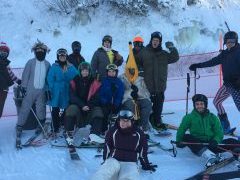
OS 12000 Alpine Skiing and Snowboarding
4 credits
Winter Block
Instructor: Michael Kaplan 313-G Grant mkaplan@alaskapacific.edu
Meeting Times: See attached daily schedule and calendar view, schedule at a glance
Course Description:
During this course, students learn and practice the fundamentals of snowboarding or alpine skiing, employing the American Teaching System (ATS) created by the national organization of Professional Ski Instructors of America (PSIA) and the American Association of Snowboard Instructors (AASI). In a resort setting, and in partnership with a established ski and snowboard schools, students advance at their own pace, from novice to intermediate to expert.
Learning Objectives:
After successfully completing this course, students can:
1. demonstrate improvement in skiing or snowboarding skills.
2. continue improving at skiing and snowboarding, independently, having reviewed the fundamentals of the sport.
3. demonstrate an understanding of the alpine resort industry, by means of extensive exposure to the practices of the ski and snowboard school, a practicum with an adaptive program, reading a history of the sport, and writing about their own learning experience.
4. practice a variety of active learning techniques, advancing pedagogic knowledge of the APU Five Competencies
Course Methods:
1) Skiing and Snowboarding Lessons: We will join the Mount Alyeska Snowsports School for lessons.
2) Students will follow formal lessons with an additional clinics and freeriding sessions with the APU instructor and other APU students. These additional sessions will employ active learning techniques, adapting the PSIA and AASI progressions, in both formal and informal fashions. Overall, we will spend 14 days at Alyeska, skiing and riding and learning. Peer Coaching, Structured Practice, and Informal Learning will fill most of our afternoons freeriding in small groups, engaging in a variety of active learning. Peer coaching, students will work together in practicing skills and reviewing lessons. Structured practice, students will pace themselves on skill drills. Informal learning, students will joyfully ride and emphasize the fun of the sport.
3) Students will train with Challenge Alaska, an adaptive ski and snowboarding program at Alyeska, serving people living with disabilities. Students will fulfill days of practicum with Challenge Alaska: training and shadowing lessons.
4) Students will also have play days of free riding and skiing at the resort, in pairs or small groups. During these play days students will engage in a variety of active learning techniques, including structured practice and skill training.
5) Students will keep a daily learning log/chart, documenting their progression of skill and knowledge in narrative and chart formats, following a particular reflective process related to the competency of effective communication
6) Students will engage in risk management analysis by means of reading, observing field data, and writing, advancing critical thinking skills
7) Students will read appropriate texts on the history of snowboarding and skiing, followed by the composition of an essay that links historical narrative to personal experience, advancing the competency of cultural and historical perspectives
8) Students will engage in creative expression by means of consuming literary and visual art inspired by snow sports and producing their own expressions, advancing the competency of effective communication
9) Students will engage in a citizen science project and fair called ‘Chairlift Citizen Science,’ advancing the competency of scientific inquiry
10) Students will study applications of the Skier’s Responsibility Code, advancing the competency of ethical engagement
11) Post Course Evaluation: All students will meet with the instructor for an individual post course interview. This interview will provide an opportunity to acknowledge accomplishments and reflect upon lessons learned.
ACADEMIC ASSIGNMENT EXPECTATIONS:
Students pursuing FOUR CREDITS will complete ALL ASSIGNMENTS #1-#5
ACTIVE LEARNING STATEMENT
We will engage ‘APU active learning,’ combining conventional skill instruction (formal lessons according to the best practices of professional associations) with interactive learning, exercising experiential pedagogy. We will experiment and practice with a variety of teaching and learning techniques, including peer coaching, structured practice, and informal learning. These approach demands a peculiar responsibility that students and the instructor share, creating a unique brand of learning.
GRADING: Students will earn a letter grade based upon an integrated assessment of the following components:
1) Participation and commitment to skill development, including:
Punctuality at all meeting times including and Demonstration of effort in lessons and practice
2) Docility, Mature Judgment, and Proper Risk Management:
Ability to follow rules, directions, and instructions
3) Enduring Understandings:
Ability to document learning in daily logs and written assignments, linking your skill development to larger themes that transcend this course
4) Reading and Writing:
Ability to document critical and creative engagement with course topics by reading assigned texts and writing short essays.
5) Contribution to a Positive Peer Culture:
All students will contribution to a positive peer culture. Contributions should include peer coaching and peer leadership during free riding and skiing.
ATTENDANCE POLICY:
This course is intensive. Each morning, once students arrive and join the course they are ‘in class’ until we return to campus (or officially sign out at another time).
While in attendance, students are expected to behave appropriately, bearing in mind that we will be guests at Alyeska Resort. Behavioral standards for this course will be higher than regular on-campus courses; students are expected to be models of courteousness, graciousness, thoughtfulness, and cooperative kindness.
The instructor reserves the right to administratively withdraw a student at any time during the course for misbehavior and inability to follow instructions.
The census date is January th and the last day to withdraw with W is January 26th.
RISK MANAGEMENT AND PHYSICAL SAFETY:
This course is designed to introduce students to an action sport in a manner that reduces incidents of injury, instructing appropriate techniques and internalizing the Responsibility Code (as enforced by Alyeska Resort). The APU class will be indoctrinated in this code. Memorize it.
The Responsibility Code.
• Always stay in control, and be able to stop or avoid other people or objects.
• People ahead of you have the right of way. It is your responsibility to avoid them.
• You must not stop where you obstruct a trail, or are not visible from above.
• Whenever starting downhill or merging into a trail, look uphill and yield to others.
• Always use devices to help prevent runaway equipment.
• Observe all posted signs and warnings. Keep off closed trails and out of closed areas.
• Prior to using any lift, you must have the knowledge and ability to load, ride and unload safely.
In addition to the code all APU students will:
i)Wear winter helmets
ii) Ski and ride with a partner, at all times. If separated from a partner, students will descend down to a groomed main trail (or easiest way down), and regroup at the last lift. If the partners are unable to regroup, the students must descend the easiest way down to the day lodge and regroup at our contact point, the MLC desk.
iii)Have a clear contact point with the instructor at all times, including regular check ins. (cell phone 907 250 7816, contact at day lodge desk)
iv) Practice Wellness Strategies (proper rest, nutrition, training, recognition of early warning signs of cold injury) We will review the early warning signs of cold injury, and instruct to warm up frequently on especially cold days.
CLASS CITIZENSHIP AND EMOTIONAL SAFETY:
Students have a right to feel safe in expressing opinions and not have other students either take over the class or be rude to you or them.
- We will respect diversity, value dissent and minority points of view, and not condone any hateful language or behavior.
The success of this course will largely depend upon our ability to establish mutual trust and respect. In class we will be mindful of these priorities, understanding that the give and take of learning often involves emotional risk.
Americans with Disabilities Act Policy
Disability Support Services
Disability Support Services email: dss@alaskapacific.edu,
In accordance with the Americans with Disabilities Act of 1990, it is the policy of Alaska Pacific University to make reasonable accommodations for qualified students with disabilities. If a student with a disability would like to request reasonable accommodations, the student must notify the Disability Support Services (DSS) Office in a timely manner. Once the student contacts DSS, the interactive request process for reasonable accommodations will begin. Students will be notified via APU email when their request for reasonable accommodations has been reviewed and what the next steps will be. Students must check their APU email for updates on the status of their request.
To request reasonable accommodations with respect to a University course, a student must follow the process described above. If approved, it is the student’s responsibility to present the approval letter to the faculty member. Faculty members are not expected nor required to make reasonable accommodations for students with documented disability who have not been officially approved for reasonable accommodations through the DSS Office. Official approval is in the form of the DSS approval letter that documents the approved reasonable accommodation(s) with respect to the University course. The DSS Office will not discuss a student’s reasonable accommodations with a faculty member without prior written consent from that student.
Honor Policy
APU is a community of learners where all enjoy freedoms and privileges based on mutual trust and respect as well as a clear sense of responsibility. Students affirm that they will do all assigned work honestly and with integrity. Examples of prohibited conduct include cheating on examinations and submitting the work of others as one’s own, including AI-generated content. Students who engage in such activities will be subject to disciplinary measures, which may include failure in the course or expulsion from the university.
Assessment:
Some of your work from this course may be used for assessing the general or major objectives of the University. If used, it will be used confidentially.
Census Date: January 8, 2026.
Last Day to Withdraw: January 26, 2026
Websites For Reference
American Association of Snowboarding Instructors and Professional Ski Instructors of America:
APU Honor policy:
Students are expected to do all work assigned, to do it honestly and with integrity, and to ensure that the instructor has actually received the work. As noted in the Student Handbook, cheating on examinations, plagiarism, or submitting the work of others’ as one’s own, including materials solicited from the internet sources, are specific examples of prohibited conduct. Students who engage in such activities will be subject to disciplinary measures, which may include failure in the course or expulsion from the university.
Suggested Books, none are required for purchase: see Books and articles page for purchasing ideas
Susanna Howe. 1998. Sick: A Cultural History of Snowboarding.New York:St. Martin’s
Wayne K Sheldrake. 2007. Instant Karma: The Heart and Soul of a Ski Bum. Denver: Ghost Road Press.
Selections from Robert Rhinehart and Synthia Sydnor (eds.). 2003. To The Extreme: Adventure Sports, Inside and Out. State University of New York Press. Albany.
Lukas Huffman. 2006. ir77, elements of snowboarding. Pulp Publishing.
Roland Huntford. 2008. Two Planks and a Passion. New York: Continuum.
 SHREDEDX