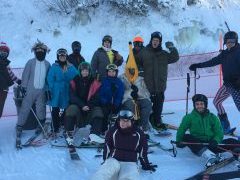
CHAIRLIFT CITIZEN SCIENCE:
Develop your SKILLS OF SCIENTIFIC OBSERVATION on the slopes and from the bird’s eye perspective of the chairlift!
AND/OR
Develop your ability to observe and innovate hacks and equipment design.
Scientific Inquiry (SI): Student will primarily enhance their fundamental SI with exercises in close observation and naturalistic inquiry design, practicing Citizen Science, innovating practical hacks, and explore the research and development of equipment design.
Purpose: To foster a scientific mind by exploring aspects of close observation and the inquiry of everyday experiences.
Competency: Scientific Inquiry From the APU CATALOG
Scientific inquiry involves critical observation and documentation of the natural and social environments within which we live. Related to the biological/physical sciences, inquiry requires the development of knowledge to collect and interpret data from the natural world, investigate fundamental aspects of that data, and contextualize findings. Related to the social/behavioral sciences, inquiry requires effective evaluation and contextualization of human social behavior at the individual and societal levels. Developed through appropriate research methods and applications, informed inquiry in all fields results in observations that are gleaned, analyzed, utilized, and disseminated for further understanding of the human condition and our world.
- Foundational Competency – Students demonstrate ability to observe, document, and interpret data, and further to report on findings. Students develop inquiry skills and explore conceptual frameworks in the natural and social/behavioral sciences.
Assignment:
Week One: while skiing and riding the chairlifts at Alyeska begin to imagine the resort as your ‘naturalized’ laboratory. Can you formulate a means of conduct scientific inquiry while riding the chairlifts and skiing the slopes at Alyeska? Engage in conversation about your proposed inquiry with other students and the faculty. Open yourself to the possibilities of a brand of inquiry we will call, ‘Chairlift Citizen Science.’
Alternatively, or additionally, you could focus upon equipment research and design. For example, study equipment innovations and/or practical hacks.
Burton New Step in Bindings :: https://www.youtube.com/watch?v=U9p8piIGhgw
Gadgets and Innovations promotional video
Study and practice HACKS, improve upon this list.
Submit your topic and plan for inquiry.
Week Two: Conduct your Chairlift Citizen Science, gather data and observations. Follow your plan, after gleaming suggestions from your peers and faculty.
Week Three: Analyze your data and compose your findings and/or results. Discuss your findings with your peers and faculty. Submit your report to Michael Kaplan before the end of the third weekend.
Week Four: BONUS EXTRA CREDIT Compose an abstract report and design a poster. Participate in the Chairlift Citizen Science Fair! Date and time and location TBA
Assignment #3 Rubric
| Novice | Competent | Proficient | Excellent | |
| Content | The thesis is not clear, Much of the material may be irrelevant to the overall topic or inaccurate. Details are lacking. Appropriate sources were not consulted. | The thesis may be somewhat unclear. Some material and evidence support the thesis. Some of the material is relevant, and some is not. Details are lacking. Information may include some inaccuracies. At least some sources were appropriate. | The thesis is clear. An adequate amount of material is relevant. This material includes details. Information is mostly accurate; any inaccuracies are minor and do not interfere with the points made. Appropriate sources were consulted. | The thesis is clear. A large amount and variety of material and evidence support the thesis. All material is relevant. This material includes details. Information is accurate. Appropriate sources were consulted. |
| Reasoning and Evidence | Information is not related to the point(s) the material is intended to support. Information is not organized in a logical manner. Material does not flow. Information is presented as a sequence of unrelated material. | Some of the information is related to the point(s) the material is intended to support, but connections are not explained. Information is not entirely organized in a logical manner, although some structure is apparent. Flow is choppy. Introductions, transitions, and other connecting material may be lacking or unsuccessful. | Information is clearly related to the point(s) the material is intended to support, although not all connections may be explained. Information is organized in a logical manner. Flow is adequate. Introductions, transitions, and other connection materials take the listener/reader along for the most part. Any abrupt transitions do not interfere with intended meaning. | Information is clearly and explicitly related to the point(s) the material is intended to support. Information is organized in a logical manner and is presented concisely. Flow is good. Introductions, transitions, and other connection materials take the listener/reader along. |
| Clarity of Written Expression | Major errors of grammar and usage make meaning unclear. Language style and word choice are ineffective and/or inappropriate. | Major errors of grammar and usage begin to interfere with meaning. Language style and word choice are simple, bland, or otherwise not very effective or not entirely appropriate. | Some errors of grammar and usage; errors do not interfere with meaning. Language style and word choice are for the most part effective and appropriate to the project. | Few errors of grammar and usage; any minor errors do not interfere with meaning. Language style and word choice are highly effective and enhance meaning. Style and word choice are appropriate to the project. |
| Scientific Inquiry | There are no scientific observations. Data presented is false or speculative. Analysis is absent. | Scientific observations are imagined, though not carried out. Data presented is speculative and poorly presented. Analysis and or conclusions are unrelated to the study design. | Scientific observations are designed and carried out. Data presented is inconsistent. Analysis and conclusions drawn are within the study design, could be more developed. | Scientific observations are designed and carried out. Data presented has a strong, consistent validity and analysis or conclusions provoke thought and knowledge. |
 SHREDEDX