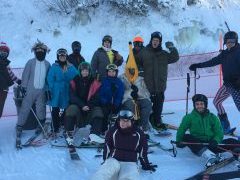
Ethical Engagment (EE): Students will enhance their fundamental EE competency by gaining knowledge of the skiers code and applying/adapting that code to volunteering with Challenge Alaska .
Purpose: To gain factual and applicable knowledge about ethical engagement through the practice of developing codes of conduct appropriate for skiing and snowboarding, including skiing and riding with people living with disabilities
Formal Definition from the APU Catalog
Ethical Engagement
Ethical engagement involves the way in which we make choices between competing moral principles, determine who or what is good, and question how we live a good life. Ethical engagement requires examination of rights, obligations, benefits, and fairness. Ethical engagement requires consideration of how moral standards are reasoned, and how such standards espouse virtuous action as well as obligations to refrain from bad actions. On a personal level, ethical engagement requires the examination of one’s own standards to develop self-direction and responsibility for individual decisions and actions. On a societal level, ethical engagement develops the capability to face challenging dilemmas through principled guidelines. Further, with attention to local and global sustainability, ethical engagement develops the capacity for creative and critical care of our world.
-
Foundational Competency – Students demonstrate the ability to reason through questions of right and wrong, good and bad, and rights and responsibilities. Students develop personal responsibility with attention to self-direction and individual decision-making. Students develop social responsibility with attention to the contested and enduring question of what is good for individuals and society.
STEP ONE : LEARN THE SKIERS RESPONSIBILITY CODE AS EXPLAINED BY ALYESKA RESORT SKI PATROL This course is designed to introduce students to an action sport in a manner that reduces incidents of injury, instructing appropriate techniques and internalizing the Responsibility Code (as enforced by Alyeska Resort). The APU class will be indoctrinated in this code. Memorize it. THE The Responsibility Code. • In addition to the code all APU students will: i)Wear winter helmets ii) Ski and ride with a partner, at all times. If separated from a partner, students will descend down to a groomed main trail (or easiest way down), and regroup at the last lift. If the partners are unable to regroup, the students must descend the easiest way down to the day lodge and regroup at our contact point, the MLC desk. iii)Have a clear contact point with the instructor at all times, including regular check ins. (cell phone 907 250 7816, contact at day lodge desk) iv) Practice Wellness Strategies (proper rest, nutrition, training, recognition of early warning signs of cold injury) We will review the early warning signs of cold injury, and instruct to warm up frequently on especially cold days.
STEP TWO : Successfully Complete the Mountain Education Test online, found towards the bottom of the Ski Patrol page
STEP THREE : Participate in a DayLodge Salon with your fellow APU students and faculty, during a lunch break. The discussion topic with be ‘The Skier’s Responsibility Code and Mountain Citizenship.’
STEP FOUR: Train with Challenge Alaska
STEP FIVE: PRACTICUM Complete Shadowing Lessons with Challenge Alaska
STEP SIX: Re-examine the skiers responsibility code in light of your experience with Challenge Alaska, provide a case study. You may discuss the entire code or specific rules of it. In what way did the code apply to your experience with Challenge Alaska? Did you experience the ‘Code-in-Action’ during your time with Challenge Alaska? Compose a short essay (target length 250-500 words) be prepared to discuss it with your classmates.
Assessment Rubric for Assignment #1
|
Novice |
Competent |
Proficient |
Excellent |
|
|
Content |
The thesis is not clear, Much of the material may be irrelevant to the overall topic or inaccurate. Details are lacking. Appropriate sources were not consulted. |
The thesis may be somewhat unclear. Some material and evidence support the thesis. Some of the material is relevant, and some is not. Details are lacking. Information may include some inaccuracies. At least some sources were appropriate. |
The thesis is clear. An adequate amount of material is relevant. This material includes details. Information is mostly accurate; any inaccuracies are minor and do not interfere with the points made. Appropriate sources were consulted. |
The thesis is clear. A large amount and variety of material and evidence support the thesis. All material is relevant. This material includes details. Information is accurate. Appropriate sources were consulted. |
|
Reasoning and Evidence |
Information is not related to the point(s) the material is intended to support. Information is not organized in a logical manner. Material does not flow. Information is presented as a sequence of unrelated material. |
Some of the information is related to the point(s) the material is intended to support, but connections are not explained. Information is not entirely organized in a logical manner, although some structure is apparent. Flow is choppy. Introductions, transitions, and other connecting material may be lacking or unsuccessful. |
Information is clearly related to the point(s) the material is intended to support, although not all connections may be explained. Information is organized in a logical manner. Flow is adequate. Introductions, transitions, and other connection materials take the listener/reader along for the most part. Any abrupt transitions do not interfere with intended meaning. |
Information is clearly and explicitly related to the point(s) the material is intended to support. Information is organized in a logical manner and is presented concisely. Flow is good. Introductions, transitions, and other connection materials take the listener/reader along. |
|
Clarity of Written Expression |
Major errors of grammar and usage make meaning unclear. Language style and word choice are ineffective and/or inappropriate. |
Major errors of grammar and usage begin to interfere with meaning. Language style and word choice are simple, bland, or otherwise not very effective or not entirely appropriate. |
Some errors of grammar and usage; errors do not interfere with meaning. Language style and word choice are for the most part effective and appropriate to the project. |
Few errors of grammar and usage; any minor errors do not interfere with meaning. Language style and word choice are highly effective and enhance meaning. Style and word choice are appropriate to the project. |
|
Ethical Engagement |
The skiers responsibility code is not mentioned or alluded to. Mention of ethics are slim and incoherent. |
The skiers responsibility code is integrated a few times, though not linked with experiences with Challenge. Ethical discussion is present, though weak. |
The skiers responsibility code is integrated several times, and loosely linked with experiences with Challenge. Ethical discussion is present, though not strong. |
The skiers responsibility code is integrated throughout, linked strongly to experiences with Challenge. Ethical discussion is strong and present throughout the writing. |
 SHREDEDX